Medicare (Dis)Advantage – Billions Stolen from the U.S. Government

Published with permission of the author, Alan Unell, PhD

October 15th was the start of the Medicare sign up season. In honor of that we will discuss how insurance companies become wealthy at the expense of the taxpayers. Recall that Medicare Advantage IS NOT MEDICARE. It is private insurance.

Physicians for a National Health Plan has been researching the fraud in the Medicare Advantage system and here is their groundbreaking report. These companies have stolen between $88 Billion and $140 billion from Medicare IN 2022 ALONE. Here is an overview article on today’s subject. First, some background material. 

The Balanced Budget Act of 1997 (BBA) established a new Part C of the Medicare program, known then as the Medicare+Choice (M+C) program, effective January 1999. In the early 2000s it was relabeled Medicare Advantage. It was an interesting idea, the government, in an effort to buy down risk, would pay insurers to assume the risk. That payment is a minimum $1000/month for each subscriber and higher if the insurance company claims they are sicker than nominal. Part of the idea was that the government could save money this way. However, research from the Medicare Payment Advisory Commission (MedPAC), an independent agency that advises Congress on Medicare, shows that the program has not yielded savings in the two decades since it was established. It does however, provide the most lucrative health insurance program ever, for insurance companies. It is essentially, a giveaway.

Those plans, may put a cap on subscribers yearly maximum expenditures but there is a price to pay, in copays and deductibles. We have had story after story about how the top Medicare (dis)Advantage providers have been cheating the government. The Department of Justice has suits against them for willful fraud (not mistakes).

Back to PNHPs analysis. Here’s how they cheat.

Favorable Selection

Researchers found that Medicare Advantage plans actively seek out healthier patients, targeting their marketing towards a healthier demographic in a process called “favorable selection” and “favorable deselection.”  The flat rates that the government pays to Medicare Advantage insurers is based on the costs of traditional Medicare participants, but traditional Medicare participants tend to be far sicker. Research shows that patients tend to switch to traditional Medicare as they get sicker due to Medicare Advantage plans’ narrow provider networks and restrictions on care. When that happens it becomes difficult for them to obtain a Medical-Gap plan that would limit their copay amount (20% on traditional Medicare).

MedPAC, found in June that favorable selection for a healthier Medicare Advantage population resulted in 11 percent lower costs for Medicare Advantage plans, even as insurers get paid on the basis of the traditional, higher-need Medicare population. The report estimates that these overpayments cost Medicare $44-56 billion annually.

Upcoding

We’ve discussed this before. The insurance companies list you as sicker than you are so they can increase their monthly payments from the federal government to way over the nominal $1000/month.

As The Lever covered in May, this fraudulent practice leads to $20 billion in additional spending per year — and generates more profits for insurers. 

Quality Benchmarks & County Bonuses

Currently, Medicare provides bonuses to Medicare Advantage plans based on the locations they cover, supposedly to ensure equal geographic access to coverage. But as MedPAC noted in its 2023 report, these payments “are not necessary for maintaining affordable supplemental coverage” and “fail to capture savings for the Medicare program.” Insurance companies falsely increase their quality rating and payments while frequently denying care to patients and increasing profits. The measures used allow this. The PNHP report estimates this kind of manipulation is worth approximately $24 billion to $28 billion in overcharges to the government.

Induced utilization

This is the idea that people with supplemental coverage are likely to use more health care because their insurance pays for more of their cost, removing some of the financial barriers to accessing health services. People with Medicare Advantage plans have a yearly maximum cap, whereas traditional Medicare does not – unless you buy that Gap insurance. The value is an extra $108/month/subscriber or about $36 billion for the Medicare Advantage insurance companies. They receive this directly from the monthly payments that people pay to Medicare. Not fair.

SUMMARY

Profiteers want to make our health care system even more unequal and ineffective than it already is. If we want to one day achieve improved Medicare for All, we can’t let corporate insurers have their way. We need to act now to stop them.

ACTION

Let’s educate our Congressperson and Senators about how bad the situation really is. You can find their contact information in the Resources section below. 

Here is a sample letter:

“I am your constituent and I just learned how private insurance companies are gaming the Medicare Advantage system and overbilling the US government. This is not Medicare, it is private insurance and we pay them over $1000/month to provide insurance for seniors. They deny prior authorizations (6%) and provide less healthcare than traditional Medicare, and are overbilling on the order of $140 billion in 2022 alone. Here is THE URL to a report from Physicians for a National Health Plan on the subject. PLEASE READ IT.

https://pnhp.org/system/assets/uploads/2023/09/MAOverpaymentReport_Final.pdf?eType=EmailBlastContent&eId=41d22552-20ff-488c-b5a0-189f9f2765fc

You can fix this by enacting the Improved Medicare for All system, HR 3421. No private insurance, cradle to grave coverage, no copays/deductibles to dissuade people from going to the doctor. You can fix this and I want you to do it.”

Dr Unell’s blog can be found on Substack.

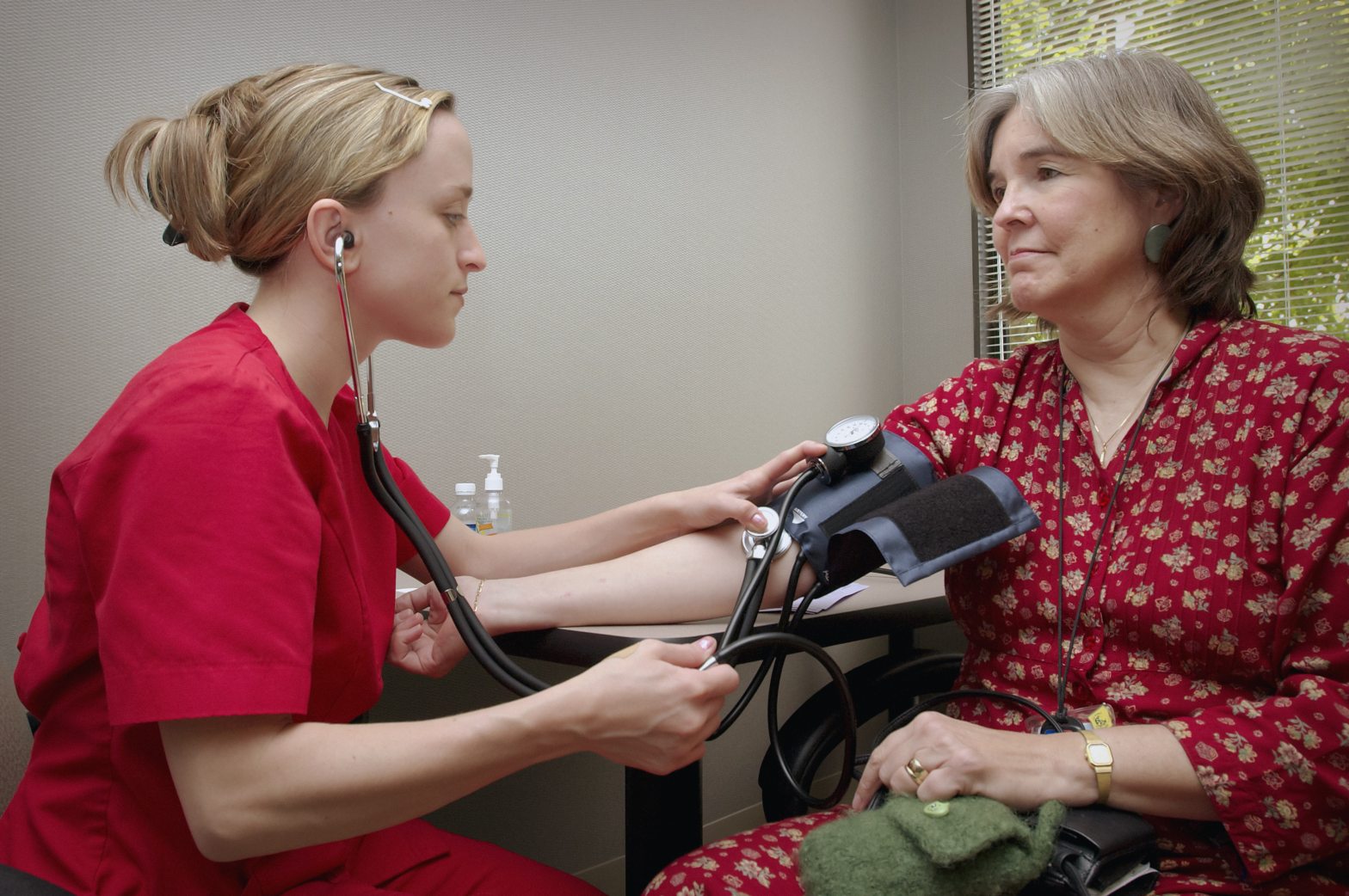
Photo by National Cancer Institute on Unsplash

Penobscot voters to consider universal health care referendum on Election Day


Originally published in the Castine Patriot, October 5, 2023

In addition to the eight state ballot questions this November, residents of Penobscot will have their own referendum to consider: “Shall the citizens of Penobscot call on the Maine Legislature to create a publicly funded healthcare plan that provides every Maine resident with comprehensive medical care?” 

David Jolly, a Penobscot resident and board member for Maine AllCare, asked the town’s select board to put the referendum on the November ballot, and the three select board members agreed to do so. Maine AllCare is a statewide nonprofit that advocates for universal health care in Maine and across the U.S.

“The Penobscot select board understands that there are many in our community who are concerned about the future of our health care system,” said select board member Sara Leighton in a press release. “We feel it’s important for our citizens to make their voices heard. We are very proud that Penobscot is the first town in Maine to have this type of ballot initiative on universal health care, and it is our hope that voters come out in droves to weigh in on this important issue.” 

Maine AllCare volunteers have presented similar measures to town select boards and city councils and 12 have passed, including one in Penobscot in 2020. The current effort in Penobscot is the first time the question is being put directly to voters on the November ballot. (Voters in Trenton and Woolwich passed similar resolutions at their annual town meetings in 2021.) 

If the Penobscot referendum succeeds, Maine AllCare intends to launch similar initiatives in towns and cities across the state, with the goal of demonstrating that there is widespread support for a publicly funded universal health care system in Maine.

Maine AllCare held an informational session on the referendum October 4 at Penobscot Community School to provide information about the referendum and the state of health care in Maine and to talk with attendees about their views, experiences and concerns.

The Penobscot select board will conduct a public hearing about the referendum on Tuesday, October 17, from 6 to 7 p.m. at the school, giving residents another opportunity to discuss issues related to the referendum.

“Comprehensive health care reform is unlikely at the federal level any time soon,” David Jolly said in the release. “But change is possible at the state level and Maine AllCare wants to put pressure on our legislators to make that happen. That’s why we’re asking the people of Penobscot to vote yes on this referendum.”

For more information, contact David Jolly at dhjolly49@gmail.com or visit maineallcare.org.

Non Profit Hospitals – Not Really

by Alan Unell, Ph.D.

We the people give businesses a huge break when we make them tax exempt. We make sure that they pay no federal or state corporate income taxes because they are involved in doing good for the public. The IRS has special rules regarding public good for hospitals. Here is a link to the law.

Unfortunately those rules, and most of the state rules on the subject are vague and allow hospitals to decide what constitutes public good. Some have found advertising campaigns constitute public good, in that their ads contained a public health message inside an advertisement. Many tax exempt hospitals sell the debt of patients unable to pay to collection agencies and many of those patients wind up in bankruptcy. I don’t know about you, but in my mind , treating people unable to pay constitutes the greatest good a hospital could possibly do.

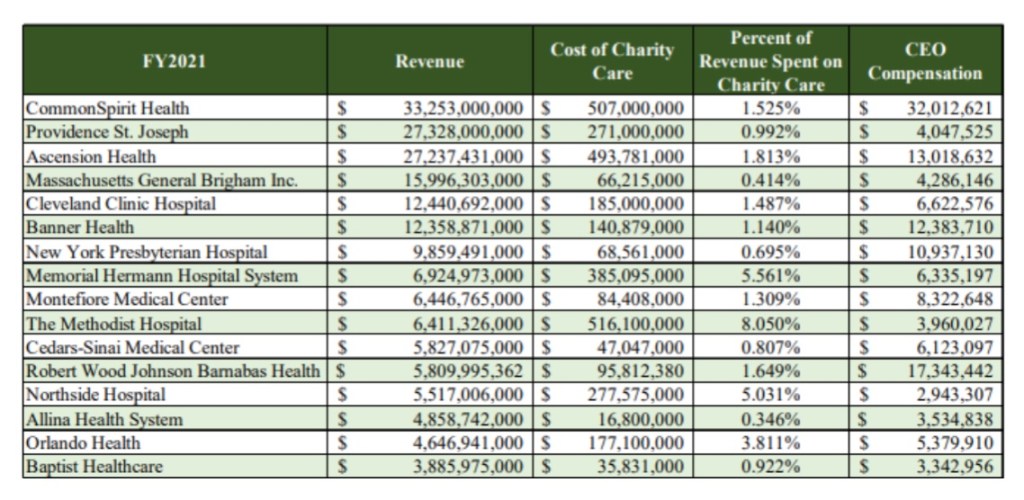
Yesterday Senator Bernie Sanders released a report on the subject. He is chairman of the Senate Health, Education, Labor and Pensions committee. He found six of the biggest nonprofit hospital systems dedicated less than 1% of their total revenue to charity care in 2021 what should be a key criteria for maintaining their tax-exempt status.

One study, mentioned in the report, found that in 2017 tax exempt hospitals billed patients $2.7 billion when they should have eligible for charity care. Hospitals make it hard to figure out how to access charity care that they are supposed to offer. The reference is in the linked report(#12)

This chart was in the report and it is quite an eye opener.

Look at CommonSpirit Health. They spent 1.52% of revenue on charity care and paid their CEO $32 million. Or New York Presbyterian, with 0.695% spent on charity care and almost $11 million for their CEO.

While we are at it, another study found that the amount spent of charity care is far less than the amount of the tax breaks they get from the government. Non-profit hospitals spent only an estimated $16 billion on charity care in 2020, or about 57 percent of the value of their tax breaks in the same year. The reference is in the linked report (#10). There are a little more than 6000 hospitals in the US and about 3000 are non profit and tax exempt. Yet they make 44% of their profit from the federal, state and local tax breaks. WHAT A SCAM!!!

Even the General Accounting Office has weighed in and found this to be shameful. To quote their recent report to be Tax Exempt a hospital must 

  • Meet legal requirements, e.g., set billing and collection limits
  • Provide community benefits, e.g., run an emergency room that’s open to all—regardless of ability to pay

While the legal requirements are easy for IRS to confirm, it’s harder to verify community benefits because the law isn’t specific about which services qualify. Revising tax forms so hospitals can better share such information may help justify exemptions. Their prior report asked Congress to consider clarifying the law and recommended ways to improve IRS oversight. 

We can do more – let’s let our legislature know how tax exempt hospitals have found a way to scam the system and pay exorbitant salaries to CEOs, pay little for charitable healthcare, sell patients debt to collection agencies and force the now indigent patients into bankruptcy. 

ACTION

Lets educate our representatives about this and ask them to implement firm IRS tax rules about how much charitable healthcare has to be offered to maintain their tax exempt status. A tithe or 10% sounds fair. Also they should make sure hospitals make it easy to apply for charitable care, not hide that information and they should not be involved in aggressive bill collection activities (as some are). The reference section below has their contact info.

You can use RESISTBOT by texting to 50409 SIGN PSTWKL to send the email below.

“I am your constituent and I just learned that tax exempt hospitals are providing very little charitable care compared to their income. 6 of the top 16 tax exempt hospitals provide less than 1%. They are involved in aggressive bill collection, sell debt to collection agencies and drive patients into bankruptcy – and we are subsidizing this. Moreover, the charitable care they provide is vastly outweighed by the tax benefit they receive. In fact for the almost 3000 tax exempt hospitals, 44% of their profit is from their tax benefits. 

I refer you to the report submitted to the Senate’s Health Education Labor and Pensions Committee by it’s chair, Senator Sanders, on October 10, 2023. Here is a link.  https://www.sanders.senate.gov/wp-content/uploads/Executive-Charity-HELP-Committee-Majority-Staff-Report-Final.pdf

Here is what you can do. You can pass legislation that in order to maintain tax exempt status, hospitals must provide at least 10% of their income as charity care to the poor. You can demand that they publish easy to find instructions on how to apply for charity care. I want you to do this for all of us.”

Dr Unell’s blog can be found on Substack.

Hot Mess Managing Insurance

by Alan Unell, Ph.D.

Editor’s note: This Substack post is shared in its entirety, with permission of the author Alan Unell Ph.D. You can view the original post HERE. Featured photo by Owen Beard on Unsplash

A recent news article in the Bloomberg News highlights a mess in the world of employer and union health insurance. Thanks to Barbara for pointing out this issue.

Remember that about 49% of us have health insurance through our work. And 65% of all those insurance plans are self funded. That means the employer or union has set up a trust fund to pay those claims. The employer or union generally hires a claims administrator to manage the claims payment for them.

According to Bloomberg, Kraft Heinz recently accused CVS Health’s Aetna of wasting its money by paying fraudulent medical claims. Two union health insurance plans in Connecticut alleged that insurer Elevance Health routinely overpaid medical bills. And the trustees of a bankrupt trucking company accused insurer UnitedHealth Group of mismanaging millions of dollars.

Recall that about $4 trillion is spent on healthcare yearly. Employers spend about 25% of that. Some of the employers who suspect mismanagement by their claims administrators are also frustrated that the administrators refuse to provide details. Big surprise. They are spending someone else’s money and are apparently may not be too careful and don’t want to share the details.

Here’s an example of administrator “alleged” shenanigans. The Connecticut union groups’ insurer, Elevance, was supposed to get the health plan a 50% discount from hospital charges, but instead they found some bills paid at double what the hospital charged, according to their joint lawsuit filed in December in federal court in Connecticut.

Here’s another. The International Union of Bricklayers and Allied Craftworkers Local 1 paid $43,490 for a procedure billed as a skin graft at Hartford HealthCare, more than twice Elevance’s negotiated rate, according to the complaint. The unions pressed Elevance, formerly called Anthem, for detailed claims data to figure out what was going on. But the insurer resisted handing it over, according to the Connecticut unions’ lawsuit. They claimed that the union’s contract with them said they don’t have to turn over data to the union, their customer, just trust me, ok?

Remember that the non partisan Congressional Budget Office report in 2020 on universal healthcare found that no matter the parameters of the single payer implementation, we save, as a country, $400 billion yearly on claims administration and unneeded overhead. I don’t know how these lawsuits will turn out but someone should tell these employers and unions that there is a better answer. Universal Healthcare – Single Payer – the Improved Medicare for All (HR 3421, S 1655). Remember that the US government administers Medicare successfully at a 2% overhead rate for tens of millions of us.

ACTION

Let’s make sure our Congressional Representative and Senators know that there seems to be claims cheating in employer and union funded plans and that Universal healthcare (HR 3421 or S 1655) will save a fortune for all of us while providing the care that all of us need. Here is a link to their contact information.

Or you can text SIGN PVFJVF to 50409 to send the message below.

I am your constituent. I just learned that employers and unions spend about $1 trillion yearly on health insurance and about 65% of that is for self funded plans. These self funded plans are administered by some of the biggest insurance companies. Some of these administrators are being sued by companies like Kraft Heinz and by several unions for mismanaging claims, overpaying, not providing promised discounts and then refusing to be transparent about their financial management. We all deserve a healthcare system that works for all of us, not one where rife with the opportunity to cheat others. HR 3421 or S 1655 will do that at lower cost according to the CBO report in August of 2020. Enact it now.

Well Done – You’re making it another good day for healthcare reform!!

Contact the White House  https://www.whitehouse.gov/contact/

Contact your elected officials: https://www.commoncause.org/find-your-representative/

Important Healthcare Resources

League of Women Voters Healthcare Reform Toolkit

Our Newsletter resources including reproductive healthcare

Healthcare Advocacy Reading List

Organizations to Contact

National Nurses United Medicare4All
Physicians for a National Health Plan

Reproductive Health

NARAL – Pro Choice America
Planned Parenthood

Miscarriage and Abortion Hotline has references about where to procure abortion medications. They also assist women in the process of self managed abortion or miscarriage by phone or text and will respond in an hour. Details and hours of operation at their website.

United State of Women Reproductive health page (bottom of the page) has important resources such as medical support, access to Telehealth, prescriptions by mail, and legal support references.

Practice careful communications – The Digital Defense Fund has a number of tips to keep texts, calls, and internet use private. Here is their site.

If you need financial help with an abortion try abortionfunds.org

Claims Denials and Appeals & What to Do

Appeal a Healthcare Decision
Appeal/Negotiate a Hospital Bill

Insurance Commissioner in your state- This website can get you their phone number.

Save Democracy

Chop Wood, Carry Water by Jessica Cravens

RESISTBOT

Link to the RESISTBOT site to learn more

Link to Chop Wood, Carry Water Resistbot write up

Not Really Non Profit

A free public service for a better community

Editor’s note: This substack post is shared in its entirety, with permission of the author Alan Unell Ph.D. You can view the original post HERE.

Alan Unell Ph.D.

Aug 21, 2023

Happy Monday Healthcare Advocates

I appreciate all of you advocating for healthcare reform. When we raise our voices we will be heard.

Medical Debt – Revisited

Last week we discussed medical debt and how some non profit hospitals make patients sign finance contracts before receiving medical care. There was a link to some of the contracts the University of North Carolina public hospital signed with these predatory lenders for your amusement.

Now a new story comes to light about non profit hospitals suing patients and placing liens on their homes. Here is a link to the NPR story.

The Duke University School of Law and the State Treasurer’s office have been investigating this behavior and found that North Carolina hospitals sued 7,517 patients and family members over medical debt between 2017 and 2022. Here is the final report.

In some cases, spouses were targeted after their partners died. In others, patients interviewed by researchers said they’d been surprised to learn about property liens only after they tried to sell their homes or after a parent who owned the home died. Sounds predatory to me. Here are a few examples from the report:

  • An 80-year-old couple did not know there was a judgment worth roughly $90,000 against them for medical bills that were over a decade old.
  • A cancer patient survived against incredible odds, but her illness cost her financial future. She can never afford to move because the hospital has a lien on her condo and she would lose her equity if she sold the property.
  • A 70-year-old woman knows she can never retire because the hospital has a $192,385 lien against her house after her husband’s heart attack. At the time, hospital representatives had assured the couple that they could receive financial help. They didn’t.
  • A family almost lost their house and their car after a broken leg interrupted the husband’s ability to work and the hospital sued them for thousands of dollars.
  • A widower lost his wife to cancer, and the hospital put a lien against his house after canceling their payment plans and financial assistance. They had health insurance, but the lien was worth $96,997.

There are a lot of problems with this system. The medical bills are opaque and difficult to understand and prices vary wildly across hospitals. A colonoscopy can be $600 in one hospital and more than $5000 in another. Interest continues to accrue when bills are not paid, and the judgement can be renewed for decades. Once you’re in this kind of debt you are also unlikely to seek medical treatment again.

I have a question: Hospitals are supposed to have a charitable fund to help patients pay their bills. Why weren’t these people offered help? The report details accounts of elderly people who chose to work rather than be on welfare, and the few thousand they earned for food was too much to qualify for charity. It is heartbreaking that the non profit companies running hospitals as profit making ventures ignore the public and the pain they are inflicting.

In North Carolina the Treasurer is pushing for a number legal initiatives to limit such predatory behavior. They would make hospital billing more transparent, remove usurious interest and predatory collection techniques. It passed the NC senate but is waiting in the NC house for representatives to take action. Sadly this behavior is everywhere, not just North Carolina.

This kind of disgusting behavior made its way into an article in the Journal of the American Medical Association. Some researchers decided to study such medical lawsuits in Virginia. Here is what they found and did.

“A total of 50 387 lawsuits, filed by 67 Virginia hospitals, were included in the study. 33 204 (65.9%) were warrant in debt lawsuits, and 17 183 (34.1%) were wage garnishment lawsuits. (Aside – a warrant in debt is an expdited motion in court for a judgement).

The researchers noted that suing patients who can’t pay is largely at odds with the hospitals stated mission of public service. The researchers crafted a plan to see if publicity about the hospital’s predatory behavior would have an effect. After they researched the debts and wrote about them in a JAMA article they requested that media outlets publish stories about the predatory hospital behavior in Virgina. They wanted to know if if public shaming made a difference. Amazingly it does because over the next year Virginia hospitals filed 59% fewer lawsuits and 11 hospitals banned the practice altogether. Note that there were still many lawsuits.

In my state of Washington, this kind of thing does not sit well with the attorney general, Bob Ferguson. He has sued some of the larger hospital networks for violating the Charity Care law. This is legislation he requested that makes financial help available to people whose income is up to 400% of the federal poverty level. The current suit is against Providence and Swedish and two of their debt collectors Harris & Harris and Optimum Outcomes for illegally failing to notify tens of thousands of patients of the availability of charity care. I like our attorney general. I don’t like the fact that you have to sue to get help.

Summary

Let’s review. Hospitals, whether for profit or non profit, are suing patients to get bills paid. They place liens on their wages and homes. Predatory interest can accrue over decades. People then choose to avoid healthcare.

We saw that public shaming of hospitals has some effect.

We saw that a sate can decide when charity care must be offered to patients instead of forcing them into collection.

NONE OF THIS HAPPENS WHEN UNIVERSAL HEALTHCARE IS IN PLACE.

EVERYONE IN, NO ONE OUT, CRADLE TO GRAVE, BETTER FOR BUSINESS, BETTER FOR PATIENTS, BETTER FOR DOCTORS AND NURSES. WE NEED THIS NOW.

ACTION

Let’s let our Congressperson and Senators know what we learned. Here is their contact info. Hospitals are practicing predatory debt collection against patients who cannot afford their bills. Shaming the hospitals publicly for not operating in the public interest does some good, mandating charity help does some good, Universal Healthcare solves the problem.

Use RESISTBOT by texting SIGN PHHYPI to 50409 on your cell phone to send this message.

“I am your constituent. I have just learned how hospitals, even non profit hospitals are suing patients who cannot pay. The are using predatory debt collection techniques, and taking people’s homes. All of this allowed by law. The AMA found that public shaming of the hospitals has some effect on reducing this bad behavior, but it is not a complete solution. Washington State has mandated a Charity Care Law to force hospitals to offer financial assistance if you are within 400% of the federal poverty limit, but hospitals have to be sued to comply. Once in debt people are shy about going to see a doctor and their health becomes worse. I know you don’t want this situation to continue.

I most strongly urge you to enact Single Payer Universal Healthcare (HR 3421 or S. 1655) now. It eliminates medical debt, covers everyone cradle to grave. It is good for hospitals, doctors, nurses, businesses, and patients. I am counting on you.”

Well Done – You’re making it another good day for healthcare reform!!

Important Healthcare Resources

League of Women Voters Healthcare Reform Toolkit

Our Newsletter resources including reproductive healthcare

Healthcare Advocacy Reading List

Organizations to Contact

National Nurses United Medicare4All
Physicians for a National Health Plan

Reproductive Health

NARAL – Pro Choice America
Planned Parenthood

Miscarriage and Abortion Hotline has references about where to procure abortion medications. They also assist women in the process of self managed abortion or miscarriage by phone or text and will respond in an hour. Details and hours of operation at their website.

United State of Women Reproductive health page (bottom of the page) has important resources such as medical support, access to Telehealth, prescriptions by mail, and legal support references.

Practice careful communications – The Digital Defense Fund has a number of tips to keep texts, calls, and internet use private. Here is their site.

If you need financial help with an abortion try abortionfunds.org

Claims Denials and Appeals & What to Do

Appeal a Healthcare Decision
Appeal/Negotiate a Hospital Bill

Insurance Commissioner in your state- This website can get you their phone number.

Save Democracy

Chop Wood, Carry Water by Jessica Cravens

RESISTBOT

Link to the RESISTBOT site to learn more

Link to Chop Wood, Carry Water Resistbot write up

Leave a comment

Thank you for reading Healthcare Advocacy. This post is public so feel free to share it.

Share

Share Healthcare Advocacy

1 Like

Happy Birthday, Medicare!

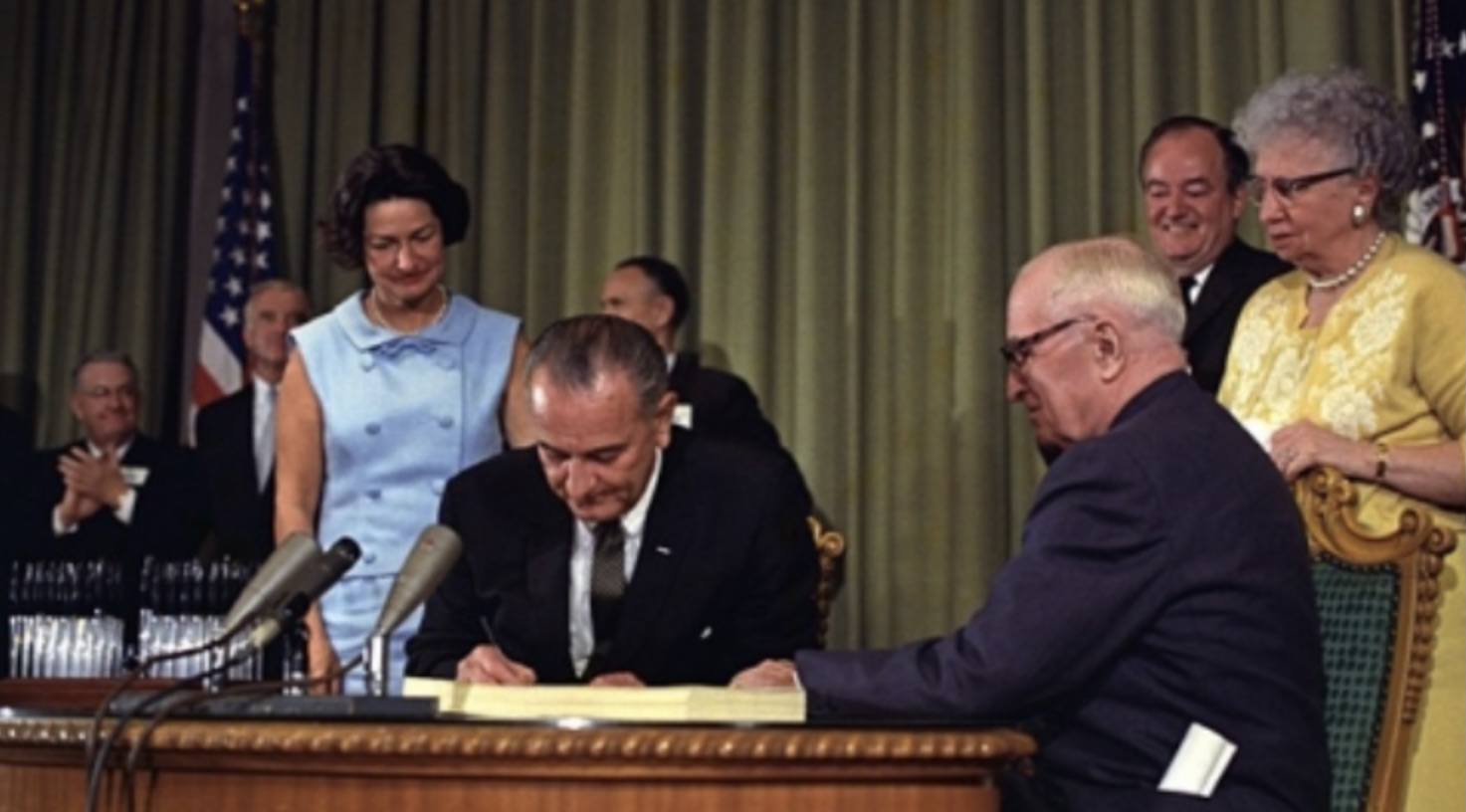
On July 30, 1965, President Lyndon Johnson signed the bill that created Medicare and Medicaid. The original Medicare program included Part A (Hospital insurance) and Part B (Medical Insurance). In 2003, the Congress made two big changes to the Medicare program, expanding coverage by creating a Prescription Drug Benefit and Medicare Advantage. However, the 2003 law also opened the doors to for-profit insurance and to Big Pharma.

Medicare Advantage is the program that allows for-profit insurance companies to offer private plans to Medicare beneficiaries, and to be paid by the federal government for each person they insure. The Medicare Advantage program was created with the promise that the private sector could reduce costs by better managing care. But as the New York Times reported in October, the quest for ever-increasing profits by the health insurance corporations offering these plans has been insatiable. Through the process of “upcoding” and making patients look sicker than they actually are, insurance corporations have been overpaid by taxpayers to the tune of TENS OF BILLIONS of dollars.

Medicare Advantage plans spend big money on advertising. Most Medicare beneficiaries receive brochures and letters every month from any number of Advantage programs.

DON’T BE DECEIVED! About 80% of the plans have “5-star” ratings (which is a bit like Lake Woebegone)

AND DON’T GET SICK!! Medicare Advantage can seem like a great deal until you actually have a serious or expensive medical event like cancer, or a stroke, or a heart attack. There is increasing evidence that seniors and people with disabilities who are on these plans face unnecessary claims and prior authorization automatic denials. They frequently find themselves unable to find covered providers and face exorbitant costs for critical care. Stat News reported that hundreds of thousands of claims for folks in Medicare Advantage plans are even being auto-denied by artificial intelligence algorithms every month. These problems will only be exacerbated as the Medicare Advantage enrollees get older and people’s health care needs increase.

Dr. Don Berwick, former head of CMS, calls the Medicare Advantage program “one of the largest transfers of wealth from public coffers to wealthy corporations and shareholders.”

Dr. Phil Caper, a co-founder of Maine AllCare, has stated repeatedly: “The underlying pathology in our health care system is runaway greed within the publicly traded companies that exist to make its shareholders and its corporate executives as wealthy as possible. The way we pay (i.e. using the managed care model) is not necessarily the problem. It’s the behaviors and abuses that are fueled by GREED.”

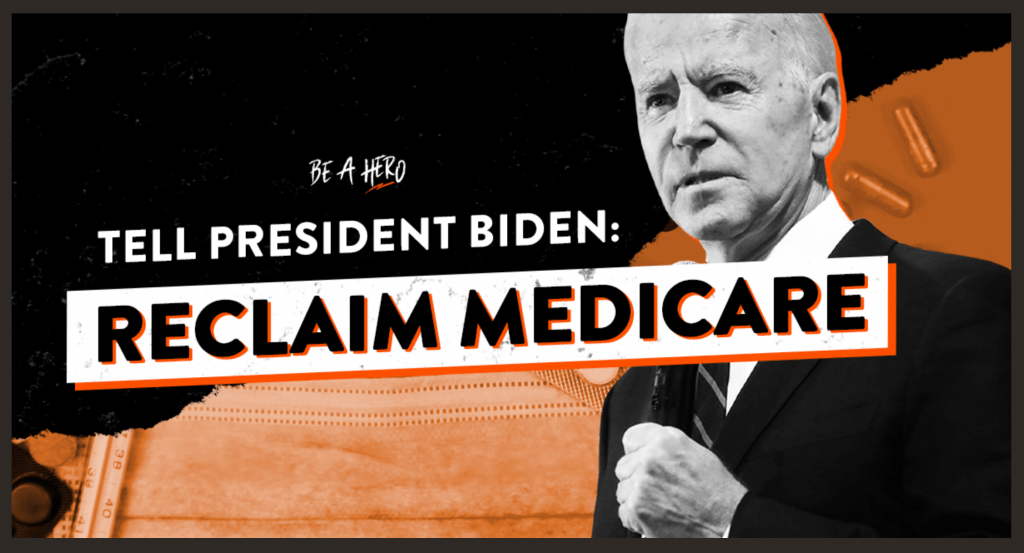
This is where “Be a Hero” comes in. Be a Hero is an organization founded by Ady Barkan, an organizer who is fighting his own battle with ALS. In his dying days, he is taking on the medical industrial complex and corporate greed. This summer, Be A Hero has launched a campaign to Reclaim Medicare.

“When everyday people make their voices heard, elected leaders like President Biden feel the pressure to act on behalf of everyday people, not corporate interests. While it’s easy to ignore statistics, it’s much harder to ignore someone’s personal experience.”


Be a Hero’s strategy is to help people who are on Medicare Advantage share their experiences or opinions, and tell the Biden Administration that they need to address the issues created by Medicare Advantage plans. Make the issue so visible that President Biden cannot ignore it, and ask him to do everything in his power to make changes through executive action.

HealthCare for All Maine and Maine AllCare asking you to:

Sign the Be a Hero petition and
Email President Biden and ask him to take executive action and to direct his administration to everything in their power to DO THREE THINGS:
1. Improve Medicare so that people have the freedom to just choose Medicare.
2. Stop wrongful delays and denials of care in Medicare Advantage plans.
3. Hold corporations accountable by ending rampant profiteering, kicking the bad actors out and mandating transparency in Medicare Advantage plans.

THEN – On July 30th, the day of action, join us and encourage your friends and family to celebrate Medicare’s birthday! HealthCare for All Maine is hoping to recruit as many participants as possible for the Day of Action on July 30th, Medicare’s Birthday. We are asking you to do TWO things on July 30th:

  1. Post something on Social Media – a photo of a hand-drawn birthday card, a photo of you or your friends holding a birthday cake. Say Happy Birthday to Medicare. Hashtags #HBDMedicare and #ReclaimMedicare
  2. Text President Biden at (302) 404-0880 and ask him to Reclaim Medicare from Corporate Greed

For more information about Be a Hero, visit their WEBSITE. For more information about Maine AllCare, click HERE.

Improving Health Care in Maine: What Can We Do?

In February and March 2023, HealthCare for All Maine coordinated a series of six talks with Maine legislators: “Improving Health Care in Maine: What Can We Do?” This summary describes each of the talks, with links to the print materials that were distributed during the sessions. You may also view and download the full 31-page document HERE.

  1. Complexity and Waste in our Healthcare System Physician and former state senator, Dr. Geoff Gratwick outlines the problems with our current healthcare system. The US healthcare system is focused on profit. It is expensive, wasteful, and confusing for everyone. Maine spends 23-25% of its total state economic product on health care, the US 18% and Canada and the E.U. 10-12%. Yet, the U.S. ranks somewhere between 21st and 35th in terms of population health. “The obstacles to change are political, not economic or medical,” says Dr. Gratwick.
  2. Business impacts: a better model for healthcare in Maine – Emergency physician Dr. Henk Goorhuis discusses how our healthcare system affects Maine businesses. He proposes a state coverage plan, “broadly imagined by coverage categories”, citing examples of initiatives in Maine and in other states. A second handout summarizes ten years of legislative initiatives in Maine.
  3. Rural Health Care in Maine: Essential and At Risk – Dr. Ted Sussman, Houlton internist, outlines the health care access problems facing rural Maine residents. Twenty-eight percent of rural Maine hospitals are at risk of closing, including four at immediate risk.  Fifteen of sixteen Maine counties have health professional shortages in primary care, mental health, and dental health. “Having adequate health insurance is of little value if there is no Emergency Department, Laboratory facility or treatment capability available in a resident’s community”, says Dr. Sussman. More rural healthcare information can be found HERE.
  4. Rural Health Inequities in Maine: Place Matters – Dr. Caryl Heaton, family physician from Blue Hill, focuses on other critical rural health issues. She notes that rural Maine people have higher rates of poverty, unemployment and economic distress, as well as lower rates of health insurance coverage and poorer population health. Dr. Heaton outlines strategies to attract healthcare providers to rural Maine areas. She also proposes a unified state healthcare program that includes global budgets for hospitals. More information from Dr. Heaton’s talk can be found HERE.
  5. Health Care: What Do People Need? – Dr. Bill Clark, Brunswick internist, discusses the stress and confusion about medical billing, including what is covered or not covered by insurance, the devastating problems of high deductibles and denial of claims for care that is delivered. He states that what we really need is access to healthcare when we need it, the freedom to choose our healthcare providers, and the ability to make healthcare decisions with those providers without interference from insurance companies.
  6. Health Care: The Way Forward – Les Fossel, small businessman and former GOP state legislator, proposes twelve possible steps to move Maine along the path to health care for everyone in Maine. He references a MECEP study from 2019 which showed that total yearly health care spending could decrease by $1.5 billion under a state-level universal plan in Maine.

Health disparities: It’s where you live and what you do

On March 23rd, Dr. Caryl Heaton delivered the last in a series of six “lunch and learn” presentations for state legislators, on the topic “Improving Health Care in Maine: What Can We Do?”

Dr. Heaton is a family physician with a special interest in health inequities. She presented her research and ideas for a system of health care for Maine that would address these inequities.

Almost two-thirds of Maine residents live in rural areas. Rural areas have higher rates of poverty, unemployment and economic distress, with lower rates of health insurance coverage and poorer population health. Fifteen Maine counties have health professional shortages in primary care, mental health and dental health.

Dr Caryl Heaton has long been an advocate of health care reform and evidence-based primary care. She has taught Family Medicine residents and students for over 30 years.

“It costs more to deliver health care services in rural areas, in part because rural hospitals and providers need to cover the costs of keeping facilities open,” said Dr. Heaton. “Maine needs a payment system for rural hospitals that supports this ‘standby capacity’ and adequately funds primary and emergency care.”

Dr. Heaton outlined strategies to attract more health care providers to rural Maine. She also proposed a unified state health care program that includes global budgets for hospitals. She states, “A unified state health care program would provide better care to more people for less money, making the system more responsive to the patients it serves, without compromising provider payment.”

A summary of Dr Heaton’s talk can be viewed HERE.
A more detailed handout about rural health disparities, including proposals to address these inequities can be downloaded HERE.

The way forward, in twelve steps

On March 16th, Les Fossel, small businessman and former GOP state legislator, gave the fifth in a series of six talks for state legislators. Sponsored by HealthCare for All Maine, the series is focused on “Improving Health Care in Maine: What Can We Do?”

Les Fossel, small businessman, former GOP legislator and member of the boards of Maine AllCare and HealthCare for All Maine

Les proposed twelve possible steps to move Maine along the path to healthcare for everyone in Maine. Please download a brief summary of Les’ talk HERE. Additional information, including the rationale for all twelve steps can be viewed and downloaded HERE.

One of the twelve steps is already in the works. Senator Craig Hickman has introduced LD590, a resolution to amend the Maine Constitution to establish the right to health care. The Maine AllCare board has voted to support the resolution. Hearings will be held in the near future.

The next Lunch and Learn is scheduled for Thursday, March 23, from 12-1 pm in the Legislative Conference Room 121 of the Maine State House. Dr. Caryl Heaton will speak about health care inequities.

Patients face barriers accessing health care, even with insurance

On March 2nd, Dr. Bill Clark, retired internist and chair of the Greater Brunswick Chapter of Maine AllCare, gave the fourth in a series of six talks for state legislators. Sponsored by HealthCare for All Maine, the series is focused on “Improving Health Care in Maine: What Can We Do?”

Dr. Clark gave examples of how difficult it is to get the care one needs, even when one is covered with insurance. “Insurance these days seldom meets expectations for helping people get care, particularly preventive or routine care,” he said. He cited Bureau of Insurance statistics on the lack of health insurance coverage: over 70, 000 are entirely uncovered, and 250,000 are uninsured for part each year.

Dr. Bill Clark with Maine AllCare colleagues at the State House. From left: Dr. Clark, Drs. Henk Goorhuis, Geoff Gratwick, Phil Caper. Photo credit: K Foster

The next session in the series is scheduled for Thursday, March 16, from 12-1 pm in Legislative Conference Room 121 of the Maine State House. Former Republican legislator Les Fossel will speak to the topic “The Way Forward”.